
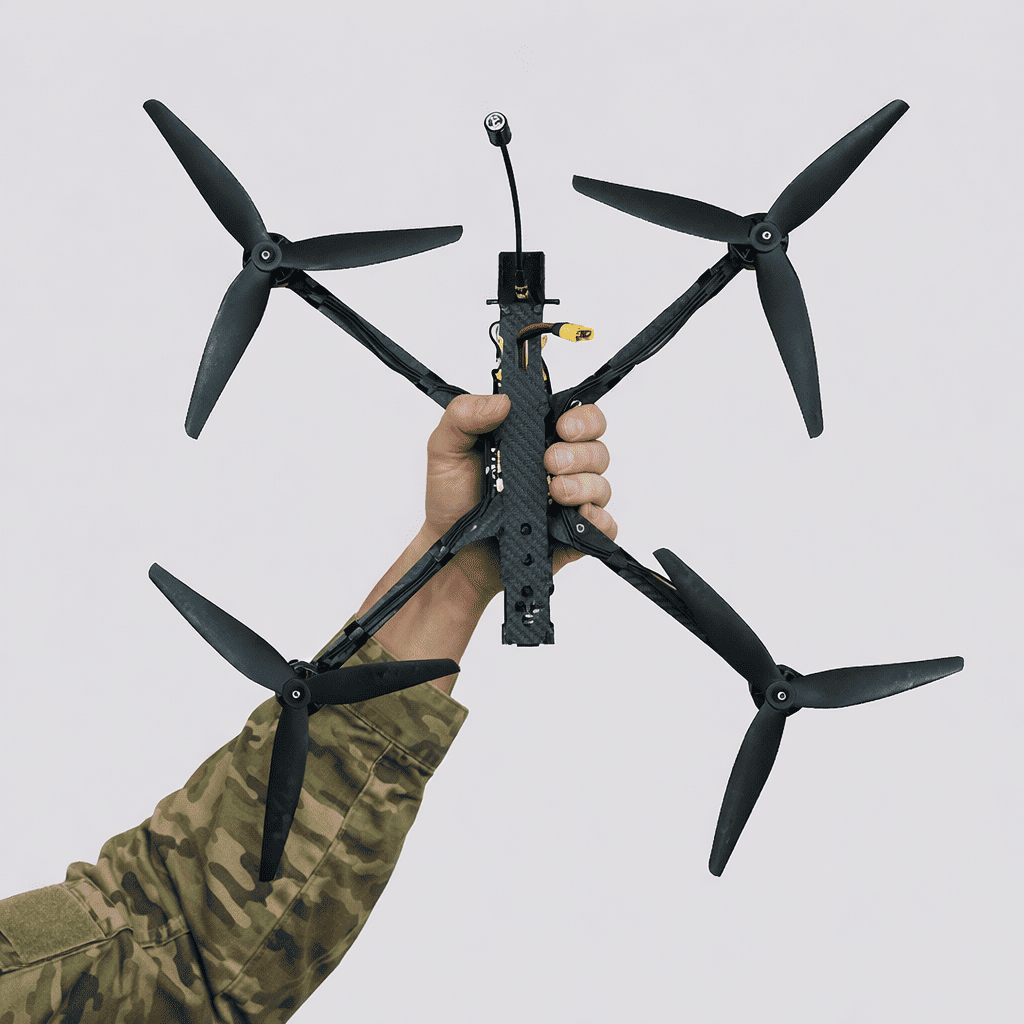
Comparative framing: what operators actually weigh
Pilots and systems engineers pick radio chains by comparing real trade-offs: range versus bandwidth, robustness versus size, and 2.4 GHz versus 5.8 GHz behavior over cluttered terrain. For teams running fpv drones military, that comparison is practical — not academic. Coaxial rotor platforms add vibration and a cramped airframe, so antenna placement, link budget and video transmitter (VTx) power become central concerns when fighting RF attenuation and multipath interference.

Common RF failure modes in coaxial dual-rotor setups
Three issues dominate field reports: line-of-sight blockage, frequency-selective fading from multipath interference, and connector losses aggravated by vibration. A coaxial rotor airframe often forces antennas inside booms or near metallic structure, worsening antenna polarization mismatch and reducing diversity reception effectiveness. Teams operating over dense urban canyons like Makati see these effects in every sortie; the city layout is a real-world anchor that shows how quickly link margin can evaporate.
Design choices compared: antenna, frequency, and reception
Match solutions to mission profile. Short-range patrols favour lower-frequency links for penetration; tasks needing high-definition feed pick higher bands for bandwidth. Compare options side-by-side:
– Omni vs directional antennas: omni gives survivable coverage while directional yields distance but needs accurate pointing. – Single-antenna VTx vs diversity receiver: diversity reception reduces deep fades at modest weight cost. – External mast mounts vs embedded antennas: external mounts improve link budget but add drag and vulnerability.
These choices intersect with coaxial rotor constraints — a mast that exposes antennas can be a liability during landing or close-in operations. Plan accordingly.
Field tactics and system tweaks that work
Small hardware and software changes often beat expensive upgrades. Adjust antenna polarization to match the ground station, trim VTx power to the minimum safe level to reduce local clutter, and tighten connector torque points to avoid intermittent loss from vibration. Use a basic link-budget check before every mission: account for free-space path loss, expected obstruction loss, and receiver sensitivity. Also, employ frequency planning to avoid civilian band congestion during urban ops.
Testing, metrics, and common mistakes
Teams that skip realistic testing pay for it in sorties. Common mistakes include: overtrusting bench tests, ignoring multipath seen in urban terrain, and underestimating connector losses. Run flight tests across the mission envelope, log RSSI and packet error rate, and collect sample video frames to quantify perceived latency and dropout. During recording, include ground control station (GCS) positional tags so you can map fading events to specific terrain features — this turns anecdote into data.
Alternatives worth comparing
If a coaxial dual-rotor platform keeps failing link expectations, consider alternatives: switch to a push‑rod tail or tilt-rotor frame for better antenna clearance; or adopt bonded diversity modules that include spatial and polarization diversity in a single low-profile housing. For teams focused on reconnaissance, a tuned external antenna array often offers better operational value than increasing VTx power. Remember: more power is not always the right answer.

Three golden rules for selecting the right RF strategy
Apply these metrics when you choose components or tactics:
1. Link margin over spec sheet: ensure at least 10–15 dB reserve beyond calculated losses under worst-case obstruction. 2. Diversity and polarization first: spatial or polarization diversity often reduces multipath fades more effectively than raw transmitter power. 3. Field-validated resilience: prioritise solutions proven in comparable environments — urban canyon tests, not just lab benches.
Conclusion: practical outcomes and where to look next
Comparing antennas, frequencies, and reception schemes delivers clear operational gains for coaxial dual-rotor teams. Implementing diversity reception and disciplined frequency planning reduces outages; improving antenna clearance and connector practices cuts intermittent faults. For actionable resources and component reviews that match these tactics, visit Military Hub — the practical guidance fits frontline needs and helps translate lab specs into reliable field performance. Short note: trust field-tested links.